

With no constant-temperature/constant-humidity process requirement, the system performs summer cooling, winter heating, fresh-air supply, air purification, and clean-zone positive-pressure maintenance. Units use a G4 primary + F7 medium filter train with terminal HEPA air-supply outlets, meeting food SC production clean-environment standards. Design conditions follow GB 50736-2012: summer 34.5°C dry-bulb / 28.5°C wet-bulb, winter -3.0°C / 82% RH.
Two schemes are compared. Scheme 1 — Air-cooled Direct-Expansion (DX) clean AHU (refrigerant system): two variable-frequency DX units (AHU-1: 6,000 m³/h, 80 kW cooling; AHU-2: 12,000 m³/h, 160 kW cooling) with rooftop condensing units, no chilled-water plant. Scheme 2 — Combined AHU + 130 air-cooled heat-pump module (water system): two AHUs plus two MTAC130BR modules and a chilled-water loop.
Cost analysis: Scheme 1 initial investment 201,329 RMB (annual operating 111,017.7 RMB); Scheme 2 initial 173,015 RMB (annual operating 139,818.20 RMB). Although the water system saves 28,314 RMB upfront, it costs 28,800.5 RMB more per year in operation. The conclusion recommends the DX system for better long-term economy.
I. Project Basic Information
Project name: China Sichuan Jijia Weilai Food Co., Ltd. Clean Workshop Air Conditioning and Purification Project
Construction location: Mianyang City, Sichuan Province, China
Construction content: This project includes two independent production areas — the vegetable-cutting workshop and the filling workshop — both at Class 100,000 cleanliness, each equipped with an independent air-conditioning and purification air-supply system. The workshops have no constant-temperature/constant-humidity process requirements; the system only performs summer cooling, winter heating, fresh-air supply, air purification, and maintaining positive pressure in the clean zone. The unit filter section is configured with a G4 primary filter + F7 medium filter, with high-efficiency air-supply outlets at the terminal, meeting the clean-environment standard for food SC production.
Outdoor air-conditioning design meteorological parameters (based on GB 50736-2012)
Parameter | Value |
|---|---|
Summer outdoor design dry-bulb temperature | 34.5°C |
Summer outdoor design wet-bulb temperature | 28.5°C |
Winter outdoor design dry-bulb temperature | -3.0°C |
Winter outdoor design relative humidity | 82% |
Design basis
(1) Technical Code for Building of Clean Room in Food Industry (GB 50687-2011) (2) Code for Design of Clean Plant (GB 50073-2013) (3) Code for Acceptance of Construction Quality of Ventilation and Air Conditioning Works (GB 50243-2016) (4) Design Code for Heating, Ventilation and Air Conditioning of Civil Buildings (GB 50736-2012) (5) Construction drawings, process layout drawings, and technical parameter requirements for equipment selection provided by the client
Equipment parameters
Vegetable-cutting workshop AHU-1: air volume 6000 m³/h, cooling capacity 80 kW, heating capacity 85 kW, external static pressure 550 Pa, variable-frequency fan
Filling workshop AHU-2: air volume 12000 m³/h, cooling capacity 160 kW, heating capacity 170 kW, external static pressure 500 Pa, variable-frequency fan
Functional-section requirements: fresh-air section, G4 primary filter section, F7 medium filter section, cooling coil section, supply-fan section
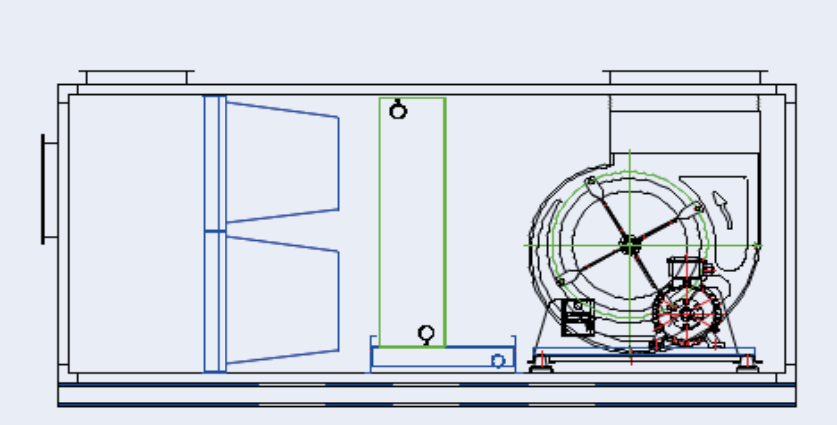
Unit schematic diagram
II. Scheme Preparation Notes
Considering this project’s workshop process conditions, load parameters, on-site installation conditions, and long-term O&M requirements, two independent technical schemes are provided for selection and quotation comparison:
Scheme 1: Air-cooled direct-expansion (DX) clean air conditioning unit scheme (refrigerant system)
Scheme 2: Combined air handling unit + 130 air-cooled module (water system)
Both schemes can satisfy all process requirements of a Class 100,000 clean workshop — air changes, cleanliness, summer cooling, and zonal positive pressure. The difference lies in system form, initial investment, machine-room footprint, O&M method, operating energy consumption, and construction period, for the builder to choose the optimal option.
III. Scheme 1: Air-Cooled Direct-Expansion (DX) Clean Air Conditioning Unit Scheme
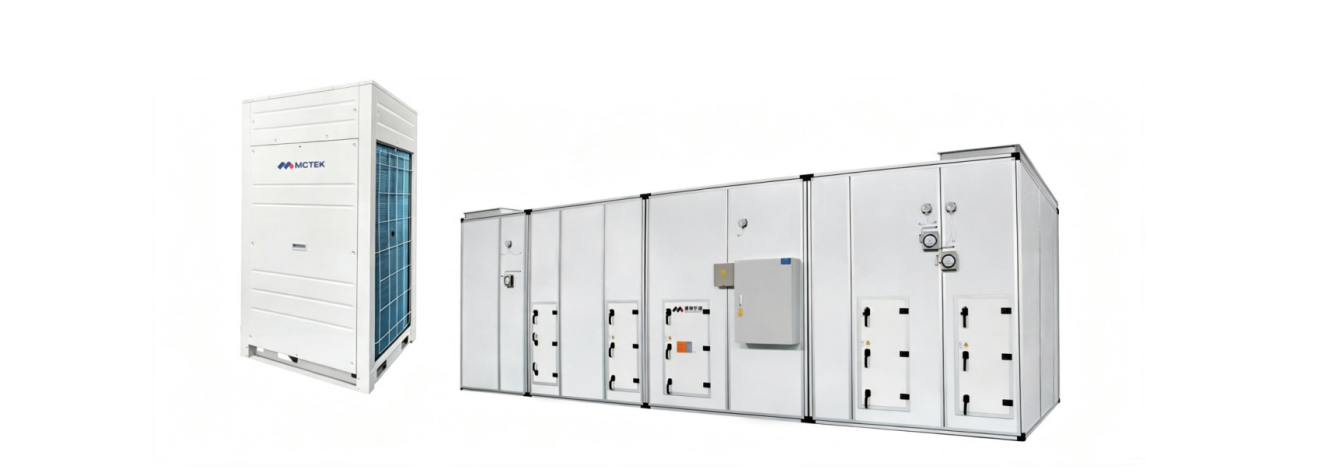
1. System Form
The vegetable-cutting workshop and filling workshop are each equipped with one air-cooled direct-expansion clean air-handling unit, with a corresponding outdoor air-cooled condensing unit. The refrigerant evaporates directly in the unit’s cooling coil for refrigeration, requiring no chilled-water host, water pump, or cooling-water system. The indoor unit integrates a mixed-air section, G4 primary filter section, F7 medium filter section, DX coil section, and supply-fan section. Both indoor and outdoor units are placed on the roof, connected by refrigerant copper piping.
2. Functional Configuration
The system provides cooling and heating functions, with no reheat or humidification functions. After fresh air enters the unit, it passes sequentially through the G4 and F7 two-stage filtration, is cooled by the DX cooling coil, and is delivered via the supply-air duct to the ceiling high-efficiency air-supply outlets and into the workshop, maintaining the Class 100,000 clean environment and summer cooling demand, and forming positive pressure in the workshop to block ingress of external polluted air.
3. Scheme Features
① Simple system composition, no dedicated chiller room required, small space occupation; ② Each workshop’s unit operates independently, can be started/stopped separately, allowing flexible staggered production; a single unit failure does not affect the other workshop; ③ Piping is refrigerant copper tubing, with no water-pipe leakage risk, suitable for food-workshop hygienic environments; ④ High equipment integration, short installation period, and few construction steps; ⑤ Simple O&M, with no ancillary equipment such as water treatment or water pumps.
Refrigerant System — Equipment and Installation Quotation
Equipment Quotation Sheet:
No. | Equipment Type | Equipment ID | Indoor Unit Model | Outdoor Unit Model | Air Volume / Fresh-Air Volume (m³/h) | Cooling Capacity (kW) | Heating Capacity (kW) | External Static Pressure (Pa) | Motor Power (kW) | Qty (units) | Settlement Price (RMB) | Remarks |
|---|---|---|---|---|---|---|---|---|---|---|---|---|
1 | Air-cooled variable-frequency DX combined air-handling unit | AHU-1 | MTDX0911ATF | MTRV280AR | 6000 / 6000 | 81 | 87 | 550 | 4 | 1 | 56,860 | Including unit control cabinet |
2 | Air-cooled variable-frequency DX combined air-handling unit | AHU-2 | MTDX1115ATF | MTRV280AR × 2 | 12000 / 12000 | 162 | 174 | 500 | 7.5 | 1 | 102,669 | Including unit control cabinet |
— | Total | 2 | 159,529 |
Refrigerant System — Installation Quotation Sheet:
No. | Item Name | Unit | Qty | Unit Price (RMB) | Total Price (RMB) | Remarks |
|---|---|---|---|---|---|---|
1 | Indoor unit installation labor | unit | 2 | 4,000 | 8,000 | Includes positioning, vibration isolation, flexible-connection installation |
2 | Outdoor unit installation labor | unit | 3 | 3,000 | 9,000 | Includes positioning, vibration-isolator pad installation |
3 | Refrigerant copper pipe and insulation material | set | 2 | 5,000 | 10,000 | 10 m one-way per set; red copper pipe + rubber-plastic insulation |
4 | Copper-pipe welding and pressure-holding labor | set | 2 | 3,000 | 6,000 | Includes welding material, nitrogen pressure-holding leak test |
5 | Pipeline supports/hangers material and installation | item | 1 | 2,000 | 2,000 | Copper-pipe supports, fixings |
6 | Control cable, conduit material and wiring labor | item | 1 | 2,000 | 2,000 | Indoor-outdoor unit connecting cable, conduit |
7 | Miscellaneous auxiliary materials | item | 1 | 800 | 800 | Adhesive, tape, aluminum foil, etc. |
8 | Hoisting fee | item | 1 | 2,500 | 2,500 | Indoor/outdoor unit hoisting and positioning |
9 | Installation and commissioning fee | item | 1 | 1,500 | 1,500 | System power-on commissioning |
— | Total (tax-excluded) | — | — | — | 41,800 |
Initial Investment — Air-Cooled DX Clean Air Conditioning Unit Scheme
Equipment price: 159,529 RMB
Installation price: 41,800 RMB
Total: 201,329 RMB
5. Annual Operating Cost Estimation for DX Units
Operating conditions:
Total indoor+outdoor unit cooling input power: 91.18 kW; total indoor+outdoor unit heating input power: 89.56 kW
(1) Cooling operation: 120 days/year, 10 h/day, load factor 0.7
(2) Heating operation: 90 days/year, 10 h/day, load factor 0.6
(3) Industrial electricity price: 0.85 RMB/kWh
Energy consumption calculation:
(1) Cooling hourly consumption = 91.18 × 0.7 = 63.83 kW Annual cooling consumption = 63.83 × 10 × 120 = 76,596 kWh Cooling electricity cost = 76,596 × 0.85 = 65,106.60 RMB
(2) Heating hourly consumption = 89.56 × 0.6 = 53.74 kW Annual heating consumption = 53.74 × 10 × 90 = 48,366 kWh Heating electricity cost = 48,366 × 0.85 = 41,111.10 RMB
Maintenance cost (filters, inspection, leak detection): 4,800.00 RMB
Annual Operating Cost Table:
No. | Name | Annual Consumption (kWh) | Unit Price (RMB/kWh) | Annual Cost (RMB) | Remarks |
|---|---|---|---|---|---|
1 | Summer cooling electricity | 76,596 | 0.85 | 65,106.6 | DX unit cooling condition |
2 | Winter heating electricity | 48,366 | 0.85 | 41,111.1 | DX heat-pump heating condition |
3 | Annual maintenance cost | — | — | 4,800 | Consumable replacement, routine inspection |
— | Total annual operating cost | — | — | 111,017.7 | Estimated reference value |
Remarks:
Load factors and operating days are engineering-experience values and may be adjusted according to the factory’s actual production situation;
Major equipment overhauls and unexpected parts replacement are not included;
Electricity price varies with local policy, and costs vary accordingly.
IV. Scheme 2: Combined Air Handling Unit + 130 Air-Cooled Module Scheme
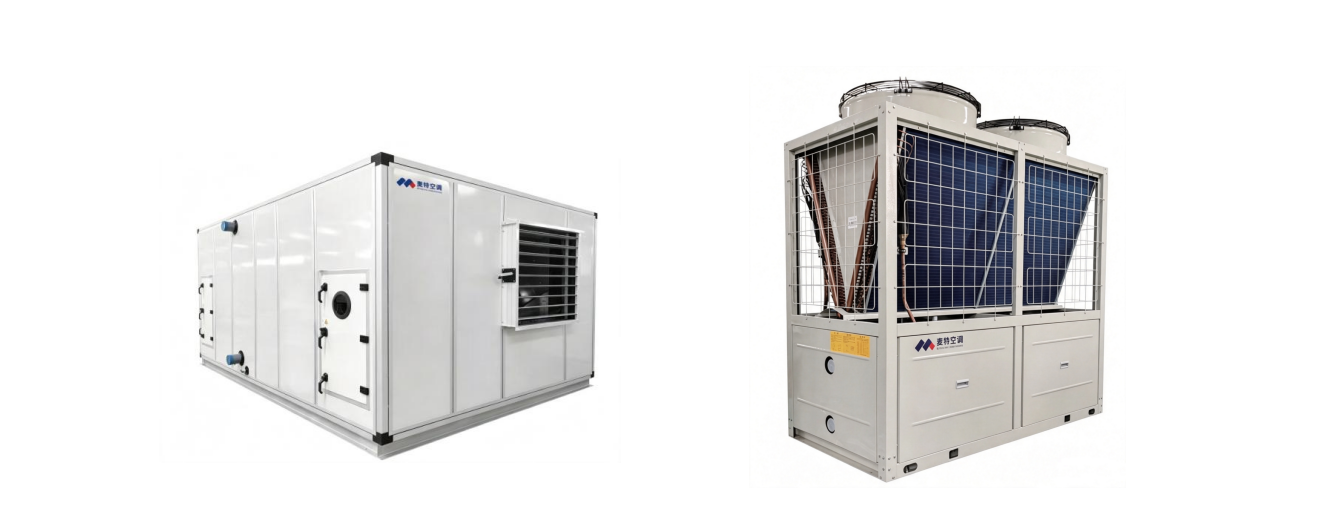
1. System Form
The cold/heat source uses 130-type air-cooled heat-pump module units as the host, placed on the outdoor roof. Two combined air-handling units are set up on the workshop side (one for the vegetable-cutting workshop, one for the filling workshop). The air-cooled modules produce chilled/hot water, which is delivered via chilled-water circulation pumps and supply/return water piping to the cooling-coil sections of the two AHUs, exchanging heat with the air to achieve workshop cooling and heating.
The combined units are configured with a fresh-air section, G4 primary filter section, F7 medium filter section, cooling-coil section, and supply-fan section. The supply-air duct connects to ceiling high-efficiency air-supply outlets to deliver air into the clean zone. The system is equipped with chilled-water pumps, expansion tank, valves, water-system insulation, and other accessories.
2. Functional Configuration
The air-cooled module is a heat-pump type: in summer it produces chilled water for workshop cooling, and in winter it produces hot water for workshop heating. The AHU only performs air heat exchange, filtration, and supply-air, with no built-in cooling/heating components. The system has no constant-temperature/constant-humidity precision control; it only achieves summer cooling, winter heating, fresh-air filtration, and maintains positive pressure in the Class 100,000 clean zone.
3. Scheme Features
① Centralized cold/heat source: two 130 air-cooled modules jointly supply cooling and heating, while the two AHU terminals independently supply air, allowing workshops to start/stop air supply independently; the host automatically starts/stops modules according to load, with good energy savings under partial-load conditions. ② No chiller room required; air-cooled modules are arranged outdoors in the open, saving indoor machine-room civil-space; no cooling tower, simple system, no cooling-water system. ③ A chilled-water piping system exists, requiring good pipe insulation, leak prevention, and freeze protection; in Mianyang’s low-temperature winter areas, pipes should add anti-freeze measures. ④ The system includes module hosts, circulation pumps, water valves, and other ancillary equipment; daily O&M includes water treatment, filter cleaning, valve inspection, and filter-element replacement — more O&M content than the DX system.
Water System — Equipment and Installation Quotation
Equipment Quotation Sheet:
No. | Equipment Type | Equipment ID | Model | Air Volume / Fresh-Air Volume (m³/h) | Cooling Capacity (kW) | Heating Capacity (kW) | External Static Pressure (Pa) | Motor Power (kW) | Water Pressure Drop (kPa) | Qty (units) | Unit Settlement Price (RMB) | Total Price (RMB) |
|---|---|---|---|---|---|---|---|---|---|---|---|---|
1 | Combined air-handling unit | AHU-01 | MTDM0812AC-HL | 6000 / 6000 | 85.4 | 95 | 550 | 4 | 41.38 | 1 | 12,140 | 12,140 |
2 | Combined air-handling unit | AHU-02 | MTDM1017AC-HL | 12000 / 12000 | 174.8 | 185 | 500 | 7.5 | 56.5 | 1 | 19,595 | 19,595 |
3 | Air-cooled module unit | — | MTAC130BR | — | 136 | 140 | — | — | — | 2 | 43,890 | 87,780 |
— | Total | 4 | 119,515 |
Water System — Installation Quotation Sheet:
No. | Item Name | Specification | Qty | Unit | Unit Price (RMB) | Total Price (RMB) | Remarks |
|---|---|---|---|---|---|---|---|
1 | 130 air-cooled module unit installation labor | Host positioning, vibration isolation, leveling, piping connection and commissioning | 2 | unit | 6,000 | 12,000 | |
2 | Combined air-handling unit installation labor | AHU hoisting, positioning, flexible connection, fixing | 2 | unit | 6,000 | 12,000 | |
3 | Chilled-water circulation pump equipment & installation | Supporting 130 module; includes vibration isolation, connection, wiring, commissioning | 2 | unit | 5,500 | 11,000 | Equipment + labor |
4 | Expansion tank equipment & installation | System pressure stabilization, water replenishment support | 1 | unit | 2,500 | 2,500 | Equipment + labor |
5 | Chilled-water piping installation | Seamless steel pipe, insulation, supports, valves, welding material, pressure test; total length 10 m | 1 | item | 8,000 | 8,000 | Includes all water-pipe aux. materials, pressure-holding leak test |
6 | System electrical & commissioning | System wiring, control-cabinet connection, overall water-filled commissioning | 1 | item | 3,000 | 3,000 | Labor + aux. materials |
7 | Miscellaneous aux. materials & hoisting | Welding rods, hoisting, angle iron, etc. | 1 | item | 5,000 | 5,000 | Lump sum |
— | Total (tax-excluded) | — | — | — | — | 53,500 |
Initial Investment — Combined AHU + 130 Air-Cooled Module Scheme
Equipment price: 119,515 RMB
Installation price: 53,500 RMB
Total: 173,015 RMB
5. Water System Annual Operating Cost Estimation
Basic parameters:
2 module hosts: total cooling input power 84.8 kW, total heating input power 84.0 kW
2 AHU fans total power: 11.5 kW
Chilled-water pump (1 unit running): 7.5 kW
Operating conditions kept consistent with the previous scheme for easy comparison:
Cooling: 120 days/year, 10 h/day, load factor 0.7
Heating: 90 days/year, 10 h/day, load factor 0.6
Industrial electricity price: 0.85 RMB/kWh
Energy consumption calculation:
(1) Cooling condition Host hourly consumption = 84.8 × 0.7 = 59.36 kW AHU fans (continuous operation) = 11.5 kW Chilled-water pump (continuous operation) = 7.5 kW Total hourly consumption = 59.36 + 11.5 + 7.5 = 78.36 kW Annual cooling consumption = 78.36 × 10 × 120 = 94,032 kWh Cooling electricity cost = 94,032 × 0.85 = 79,927.20 RMB
(3) Heating condition Host hourly consumption = 84 × 0.6 = 50.4 kW AHU fans = 11.5 kW Chilled-water pump = 7.5 kW Total hourly consumption = 50.4 + 11.5 + 7.5 = 69.4 kW Annual heating consumption = 69.4 × 10 × 90 = 62,460 kWh Heating electricity cost = 62,460 × 0.85 = 53,091.00 RMB
(4) Maintenance cost Water system includes water treatment, filter, valve maintenance, AHU filter-element replacement, estimated at 6,800.00 RMB/year
Annual Operating Cost Table:
No. | Name | Annual Consumption (kWh) | Unit Price (RMB/kWh) | Annual Cost (RMB) | Remarks |
|---|---|---|---|---|---|
1 | Summer cooling electricity | 94,032 | 0.85 | 79,927.2 | Module host + AHU fans + chilled-water pump |
2 | Winter heating electricity | 62,460 | 0.85 | 53,091 | Module heat pump + AHU fans + chilled-water pump |
3 | Annual maintenance cost | — | — | 6,800 | Filter elements, water treatment, valve maintenance, etc. |
— | Total annual operating cost | — | — | 139,818.20 | Estimated reference value |
Remarks:
Load factors and operating days follow the previous DX-scheme values for horizontal comparison; AHU fans must run for air supply in both cooling and heating conditions year-round;
Cooling tower (the air-cooled module has no cooling tower), major equipment overhauls, and unexpected parts replacement are not included;
Electricity price may be fine-tuned according to the local actual price.
V. Scheme Summary
1. Summary of Core Advantages and Disadvantages of Both Systems
System Type | Advantages | Disadvantages |
|---|---|---|
Refrigerant system (DX) | 1. Simple piping structure, no water pumps or water-system piping, low transmission energy consumption, more power-saving for long-term operation; 2. Simple equipment structure, few failure points, simple maintenance content, low maintenance cost; 3. Fast temperature-control response, flexible start/stop, enabling quick workshop heating and cooling; 4. Simple construction and commissioning, no water-logging or leakage risk, high workshop safety. | 1. Relatively dry supply air and lower indoor humidity; humidification devices must be added for high-humidity process scenarios; 2. Single-unit single-zone control — if a unit fails, the corresponding area loses air conditioning; 3. Inconvenient later expansion; adding a new area requires a complete set of indoor and outdoor units, involving substantial retrofit work; 4. Refrigerant pipes have installation-length limits, and heat exchange attenuates over long distances. |
Water system (air-cooled module + AHU) | 1. Small supply-air temperature difference and gentle airflow, with uniform and stable temperature/humidity, suitable for the process; 2. Module units can coordinate with load regulation, enabling convenient capacity expansion without modifying the main piping; 3. Main units are centrally arranged outdoors, with few indoor units, saving machine-room space; 4. Can integrate filtration, humidification, and purification functions, meeting the integrated-treatment needs of clean processes. | 1. Water pumps must run year-round, resulting in high transmission energy consumption and higher overall electricity costs; 2. Numerous water-piping fittings, with leakage and condensation risks, requiring frequent inspection and maintenance; 3. Requires periodic water treatment, descaling, and pump maintenance, resulting in higher annual O&M cost; 4. Many construction steps, with complex flushing, pressure testing, and venting/commissioning, leading to longer schedules and higher construction requirements. |
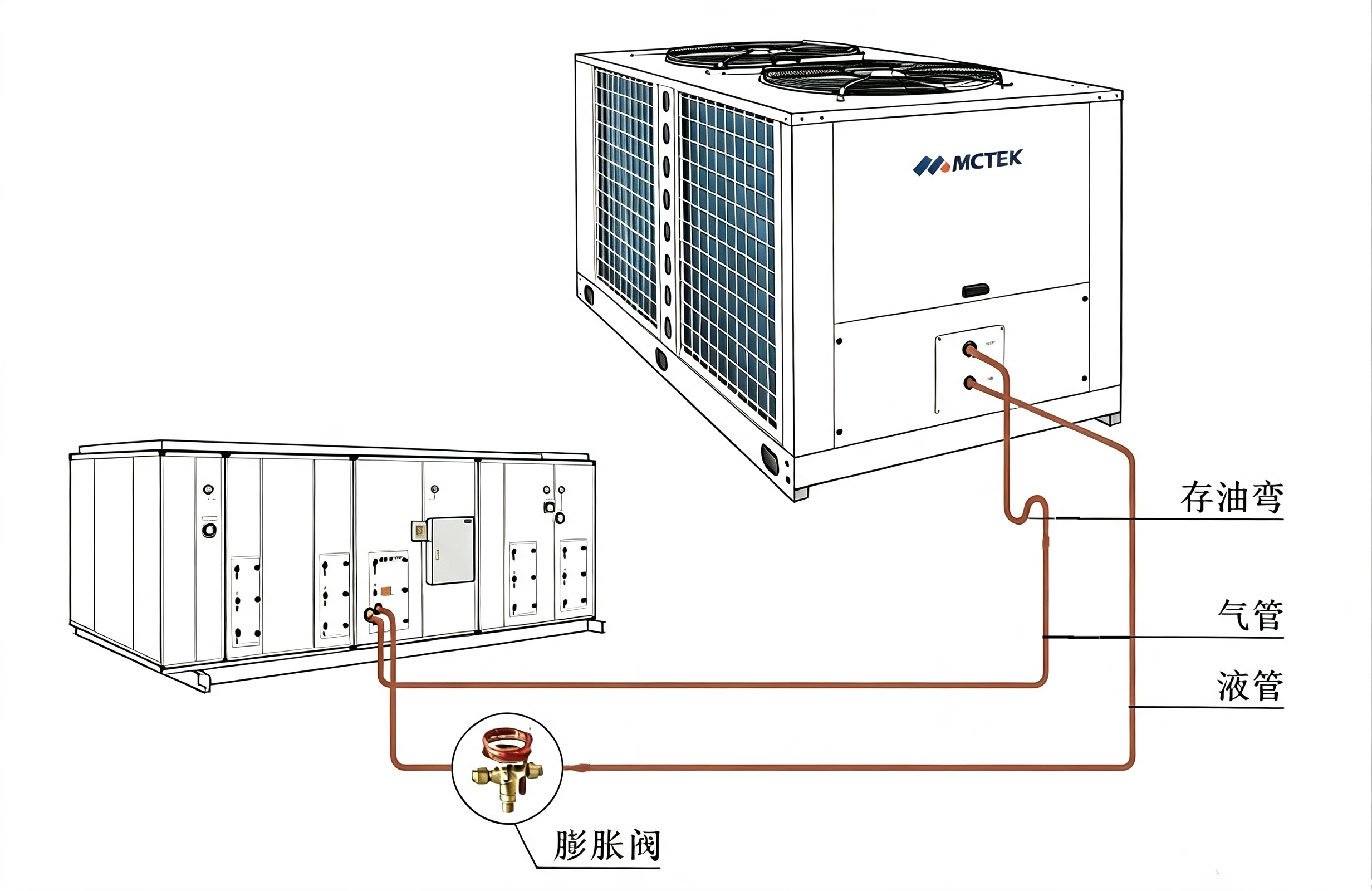
Refrigerant system installation schematic
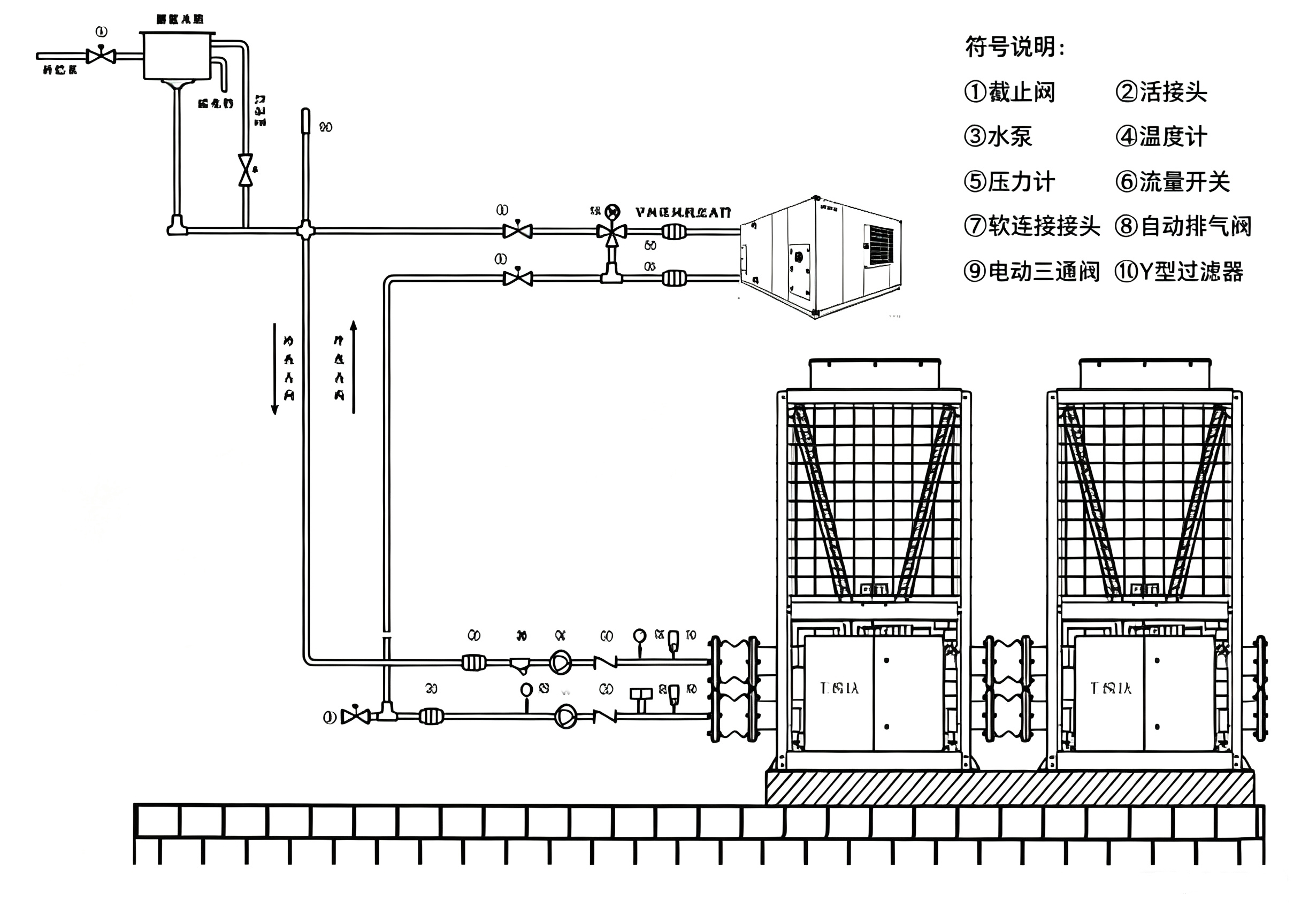
Water system installation schematic
2. Cost & Annual Operating Cost Comparison: Refrigerant (DX) System vs. Water System (Air-Cooled Module + AHU)
No. | Cost Item | Refrigerant System (DX Unit) | Water System (Air-Cooled Module + AHU) | Difference Note |
|---|---|---|---|---|
1 | Total equipment price (host + full terminal set) | 159,529 RMB | 119,515 RMB | Water system equipment is cheaper, saving 40,014 RMB |
2 | Installation engineering fee (labor + aux. materials + piping) | 41,800 RMB | 53,500 RMB | Water system has more installation steps, 35,000 RMB more expensive |
3 | Initial total investment (equipment + installation) | 201,329 RMB | 173,015 RMB | Water system initial investment is lower, saving 28,314 RMB |
4 | Annual cooling electricity | 65,106.60 RMB | 79,927.20 RMB | Water system pump + fan consume electricity year-round |
5 | Annual heating electricity | 41,111.10 RMB | 53,091.00 RMB | Same as above |
6 | Annual maintenance cost | 4,800 RMB | 6,800 RMB | Water system has more maintenance items |
7 | Total annual operating cost | 111,017.70 RMB | 139,818.20 RMB | Water system spends 28,800.5 RMB more per year |
Simple Investment Payback Analysis
Water system saves 28,314 RMB upfront;
Water system spends 28,800.5 RMB more per year in operating costs;
Conclusion: the water system operates at a net loss from the very first year, so the refrigerant (DX) system is more cost-effective over the long term.
Considering both initial investment and long-term operating energy consumption and O&M costs, the project should give priority to the refrigerant (DX) direct-expansion units, which offer better overall economy and are suitable for this workshop.