

To maintain the mandatory indoor standard of 25°C and 50% RH, the system delivers 91,000 m³/h of fresh air and 680,400 m³/h of total supply air at 15 air changes per hour, against a design heat load of 3,800 kW including safety redundancy.
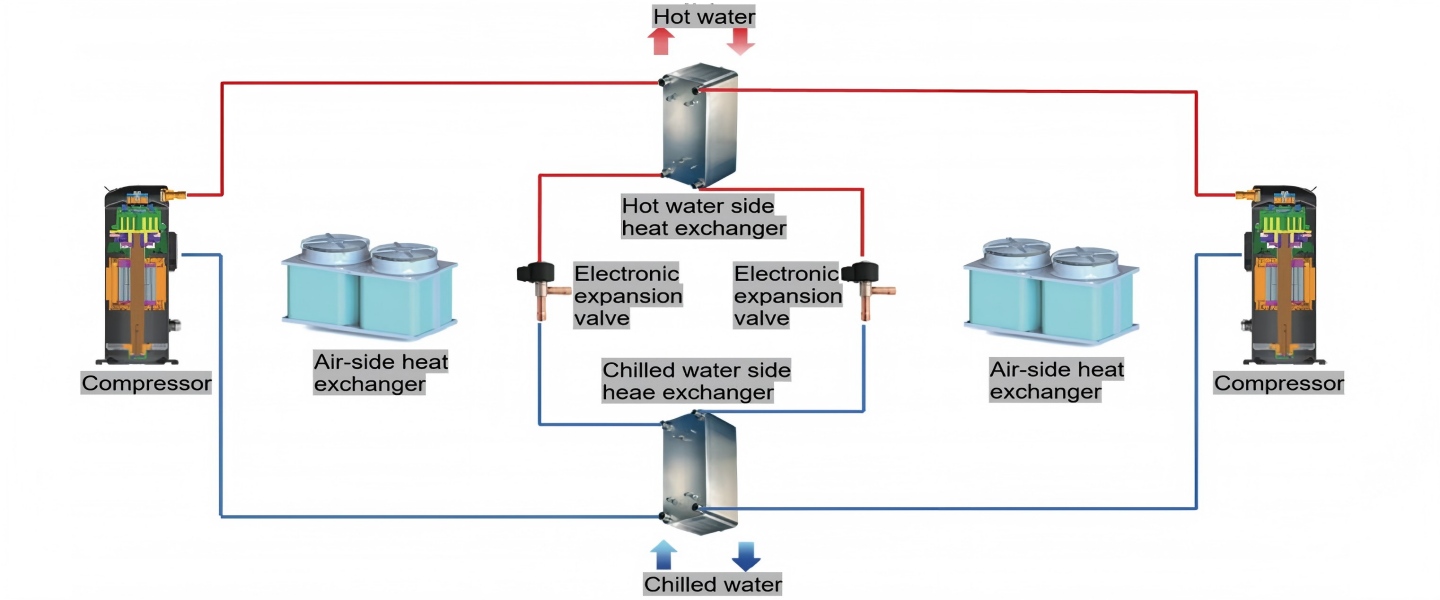
The core uses variable-frequency air-suspension water-cooled chillers (MTEC270AS, 955 kW × 4) and variable-frequency four-pipe air-cooled heat pumps (MTCH130ARVLH, 138 kW cooling / 175 kW heating × 7), with no standby units required. A two-stage process — fresh-air pre-cooling followed by precise conditioning in outdoor constant-temperature constant-humidity units — decouples temperature and humidity control. Ceiling-mounted exhaust fans remove concentrated motor heat (1,424 kW) at the source.
Three-stage G4 + F8 + H11 filtration guarantees long-term Class 100,000 cleanliness. Zoned independent cooling keeps production running if a single unit fails. Fully variable-frequency operation, pre-cooling, and zoned supply achieve over 25% energy savings versus fixed-frequency systems, while simple O&M suits local operators.
Chapter 1 Project Overview and Design Base Parameters
1.1 Plant Basic Information
Item | Specification |
|---|---|
Plant footprint area | 84 m × 90 m |
Total clean-room volume | 45,360 m³ |
Duct installation height limit | 6 m (cooling zone: below 6 m. Both equipment and ducts are selected for low-height operating conditions; no need to raise the plant building.) |
Production configuration | 4 baby diaper production lines and 2 sanitary napkin production lines, operating continuously 24 h |
Cleanliness class | Class 100,000 (100k) clean production workshop |
1.2 Outdoor Design Conditions (DRC summer: extreme high temperature and high humidity)
Parameter | Value |
|---|---|
Outdoor dry-bulb temperature | 34°C |
Outdoor relative humidity | 65% RH |
1.3 Workshop Indoor Process Control Standards (mandatory production requirements)
Parameter | Value |
|---|---|
Indoor constant temperature | 25°C |
Indoor constant relative humidity | 50% RH — temperature and humidity remain continuously stable, with no significant fluctuations |
1.4 Air Volume Design Parameters
Parameter | Value |
|---|---|
Total system fresh-air volume | 91,000 m³/h |
Total workshop supply-air volume | 680,400 m³/h |
Indoor design air changes per hour | 15 ACH/h, meeting the air-exchange and dust-replacement requirements of a Class 100,000 clean workshop |
Workshop Comprehensive Heat Load Details (including safety redundancy factor)
Heat Source Type | Heat Load | Description |
|---|---|---|
Production equipment motor heat dissipation | 1424 kW | Largest concentrated heat source in the workshop; production-line motors continuously release heat |
Lighting system heat load | 22.2 kW | Long-term operation of cleanroom lighting dissipates heat |
Operator body heat load | 22 kW | Calculated for fully-staffed production conditions |
Building envelope heat transfer load | 209.6 kW | Summer outdoor heat transfer through walls, roof, doors and windows |
Fresh-air sensible & latent heat load | 1470 kW | High-temperature, high-humidity fresh air in the DRC brings a huge dehumidification cooling load |
Total system design heat load | 3800 kW | With safety factor included for stable operation under extreme weather |
Chapter 2 Overall Refrigeration & Air Conditioning System Process Solution
2.1 Core Refrigeration Unit Configuration Plan
The system adopts a combination of two types of variable-frequency main units, without separately adding standby units, using a zoned independent cooling-supply architecture:
Variable-frequency air-suspension water-cooled chiller
Variable-frequency four-pipe air-cooled heat pump unit
Unit Parameter | Model | Cooling Capacity (kW) | Heating Capacity (kW) | Quantity (units) |
|---|---|---|---|---|
Variable-frequency air-suspension water-cooled chiller | MTEC270AS | 955 | / | 4 |
Variable-frequency four-pipe air-cooled heat pump | MTCH130ARVLH | 138 | 175 | 7 |
Unit Configuration Advantage Logic
All units are variable-frequency driven, with stepless cooling-capacity adjustment to match workshop load fluctuations;
The four-pipe air-cooled heat pump has independent cooling and heating circuits, capable of separate cooling, separate dehumidification, and separate reheating, with decoupled temperature/humidity control — avoiding the problems of excessive humidity during cooling or excessively low temperature during dehumidification;
The air-suspension compressor uses oil-free lubrication with low friction loss, delivering higher unit energy efficiency, suitable for 24 h uninterrupted production in African factories;
Units are configured by production-line zone; a single unit failure only affects a local area, so the entire plant need not stop production.
2.2 Complete Configuration of Terminal Air-Handling Equipment
The entire terminal system is divided into three types of equipment, each handling different air loads, processing fresh air + return air + concentrated equipment waste heat in stages:
Fresh-air pre-cooling combined air handling unit: Outdoor high-temperature, high-humidity fresh air first enters this unit to complete initial pre-cooling and primary dehumidification, eliminating most of the outdoor sensible-latent heat load in advance, greatly reducing the processing pressure on the downstream main air handling unit and lowering main-unit energy consumption.
Outdoor-type constant-temperature constant-humidity combined air handling unit (workshop main supply-air equipment): Pre-cooled fresh air is mixed with the workshop’s indoor return air, completing deep cooling, precise dehumidification, and constant-temperature reheating, and outputs clean air meeting the 25°C / 50% RH standard into the main production area. Filtration standard: three-stage gradient filtration — G4 primary + F8 medium + H11 high-efficiency — meeting Class 100,000 cleanliness requirements.
Ceiling-mounted exhaust fan unit (equipment-specific heat-dissipation unit): Strategically placed above the motors of the diaper and sanitary napkin production lines to locally absorb concentrated equipment heat dissipation, resolving local high-temperature and uneven temperature/humidity problems in the workshop and ensuring the production-line equipment area meets environmental standards.
2.3 Complete Air-Treatment Process Flow
Outdoor high-temperature, high-humidity fresh air → G4 primary filtration → fresh-air pre-cooling unit pre-cooling & dehumidification → into the outdoor constant-temperature constant-humidity unit;
Workshop indoor return air → return-air filtration section → mixed with pre-cooled fresh air → F8 medium filtration → H11 high-efficiency filtration → precise temperature/humidity adjustment → clean supply air delivered to the main workshop production area;
Local waste heat from production-line motors → treated locally by the ceiling-mounted exhaust fan unit → eliminates local high temperature.
2.4 Zoned Cooling Operation Architecture Design
Main units and constant-temperature constant-humidity air handling units supply cooling by zone;
Each zone is independently assigned corresponding chiller and heat-pump main-unit loads, with independent air-path circulation;
Operation logic: when a single main unit / single air handling unit fails, only the corresponding zone’s production line is affected while the rest of the workshop continues normal production, avoiding the huge production losses caused by a full-plant shutdown;
No standby main units need to be configured, reducing the initial equipment procurement investment of the project.
Chapter 3 Three Core Performance Guarantees of the System (Temperature/Humidity, Cleanliness, Energy Saving)
3.1 Precise and Stable Temperature/Humidity Guarantee System (core process advantage)
3.1.1 Two-stage fresh-air treatment to cope with the DRC’s high-temperature, high-humidity climate
Local summer fresh air at 34°C and 65% RH carries an extremely large sensible-latent heat load. If directly mixed with return air for treatment, the main-unit dehumidification energy consumption is high and temperature/humidity are difficult to balance. This solution adopts a two-stage process — fresh-air pre-cooling first + fine temperature/humidity adjustment in the main unit:
The pre-cooling stage first strips most of the moisture from the fresh air, reducing the downstream processing load;
The main unit’s four-pipe independent cooling/heating adjustment means dehumidification and temperature control do not interfere with each other, thoroughly solving the problem of excessive workshop humidity in high-temperature, high-humidity regions.
3.1.2 Dedicated ceiling exhaust fan unit eliminates local equipment high temperature
Workshop motor heat dissipation of 1424 kW is the largest heat source. Traditional unified air-supply systems easily suffer from “the overall workshop meets standards while local overheating occurs above the equipment.” This solution’s ceiling exhaust fan unit locally collects production-line hot air and discharges it outdoors, balancing the temperature field across the entire workshop, so that any location in the workshop can stably maintain 25°C and 50% RH with no local temperature/humidity deviation.
3.1.3 Variable-frequency main units dynamically match loads — no temperature/humidity fluctuation
The air-suspension water chillers and four-pipe air-cooled heat pumps are all variable-frequency regulated. When workshop capacity changes, personnel increase/decrease, or day-night temperature differences occur, the units adjust cooling/heating output in real time, avoiding the large temperature and humidity fluctuations caused by the frequent start/stop of fixed-frequency units, ensuring diaper raw-material process stability and reducing product defects.
3.1.4 Sufficient load safety redundancy
The system’s total heat load of 3800 kW already includes a safety factor. Under the DRC’s extreme summer high-temperature weather and fully-loaded workshop production conditions, the system still retains sufficient cooling margin, and temperature/humidity will not exceed limits.
3.2 Long-Term Stable Guarantee Plan for Class 100,000 Cleanliness
3.2.1 G4 + F8 + H11 three-stage progressive gradient filtration
G4 primary filter: Intercepts outdoor sand/dust, insects, large-particle dust, and fiber debris, protecting the downstream medium/high-efficiency filters, extending high-efficiency filter service life, and reducing O&M consumable costs;
F8 medium filter: Filters fine floating dust and non-woven short fibers, sharing the H11 high-efficiency filtration load;
H11 high-efficiency filter: The core filtration unit for Class 100,000 cleanliness, intercepting micron-level dust and fine production impurities, eliminating black spots and foreign-object defects on diaper surfaces.
3.2.2 Reasonable air changes + orderly airflow organization
The workshop is designed for 15 ACH/h, continuously displacing dust-laden air. Fresh air is filtered before entering the workshop; return air is uniformly recovered, filtered, and recirculated with no dead corners for dust accumulation. Ceiling units circulate air in equipment areas, avoiding dust buildup stirred up by equipment heat dissipation, maintaining long-term workshop cleanliness.
3.2.3 Filter system O&M economy
Large-particle pollutants are intercepted by the primary and medium filters, greatly reducing the clogging rate of the H11 high-efficiency filter and extending its replacement cycle. Long-term filter procurement and replacement labor costs drop significantly, suiting the reality of long consumable-transport cycles at overseas plants.
3.3 Whole-System Energy-Saving Design Plan (long-term operating cost advantage)
3.3.1 Fully variable-frequency main units greatly reduce unit energy consumption
Both the air-suspension water chillers and the variable-frequency four-pipe air-cooled heat pumps use variable-frequency compressors:
During night shifts, half-line operation, or production-stop maintenance, the units reduce speed and lower cooling output, avoiding the frequent start/stop losses of fixed-frequency units;
Loads follow production capacity dynamically in real time, achieving comprehensive energy savings of over 25% compared with traditional fixed-frequency air-conditioning systems;
The air-suspension oil-free compressor has extremely low friction loss, delivering higher cooling COP during year-round continuous operation.
3.3.2 Fresh-air pre-cooling first reduces constant-temperature constant-humidity unit load
Outdoor air in the DRC carries an extremely high sensible-latent heat load; the independent fresh-air pre-cooling stage bears the basic cooling/dehumidification load, while the downstream constant-temperature constant-humidity unit only performs fine adjustments.
3.3.3 Zoned independent cooling eliminates energy waste
Main units and terminals are independently configured by production-line zone; only the air conditioning of the currently producing area is turned on, and idle production-line units can reduce load / shut down. During half-capacity or off-peak production, the entire workshop need not run at full load, yielding outstanding energy savings.
Chapter 4 Other Comprehensive Advantages of the Solution
4.1 High continuous-production reliability, suited to overseas factory conditions
Zoned independent operation means a single unit failure only stops a local production line while the whole plant keeps producing; given the long equipment-spare transport cycles in Africa, production-stop losses are minimized;
No standby main units need to be purchased, greatly reducing the project’s initial one-time investment;
Outdoor-type constant-temperature constant-humidity units and air-cooled heat pumps can be placed in the open air, requiring no separate refrigeration machine room, saving plant civil-construction investment.
4.2 Adapted to the on-site 6 m low-height installation limit
All air ducts, air handling units, main units, and piping equipment are optimized for selection under the 6 m height limit, requiring no modification or heightening of the plant steel structure, reducing on-site civil-renovation construction costs and schedule.
4.3 Adapted to the DRC’s high-temperature outdoor operating environment
The air-cooled heat pump main units feature heat-dissipation structures optimized for the extreme 34°C high-temperature environment, so they will not trip on high-pressure protection during summer heat and operate stably throughout the year.
4.4 Simple O&M, suited to local operators
The entire system is equipped with an intelligent centralized control system that displays workshop temperature/humidity, unit load, filter pressure differential, and operating status in real time;
Automatic audible-visual alarm on faults enables rapid fault-location;
The three-stage filters have a simple remove/install structure; ordinary local O&M personnel can independently complete replacement and cleaning without requiring professional HVAC technicians to be stationed long term.
Chapter 5 Solution Summary
This air-conditioning and cooling system is tailor-made for the DRC’s tropical high-temperature, high-humidity climate and Class 100,000 dust-free diaper production workshop, with three core values:
Process guarantee: Two-stage air treatment + zoned fixed-point temperature control stably maintains the workshop’s constant 25°C, 50% RH temperature/humidity, ensuring the yield rate of diaper and sanitary napkin production;
Cleanliness guarantee: G4 + F8 + H11 three-stage gradient filtration, combined with 15 ACH/h, stably and durably meets Class 100,000 cleanroom standards and reduces foreign-object product defects;
Operating energy saving: Threefold energy-saving design — fully variable-frequency main units, fresh-air pre-cooling process, and zoned independent cooling — significantly reduces the plant’s long-term electricity expenses.
At the same time, the system addresses the practical implementation needs of overseas factories for continuous production, low-height installation, and simple O&M, solving in one go the four core pain points of high-temperature/high-humidity climate, clean production, continuous production, and operating costs, fully matching your company’s long-term production and operation requirements.