


Overview
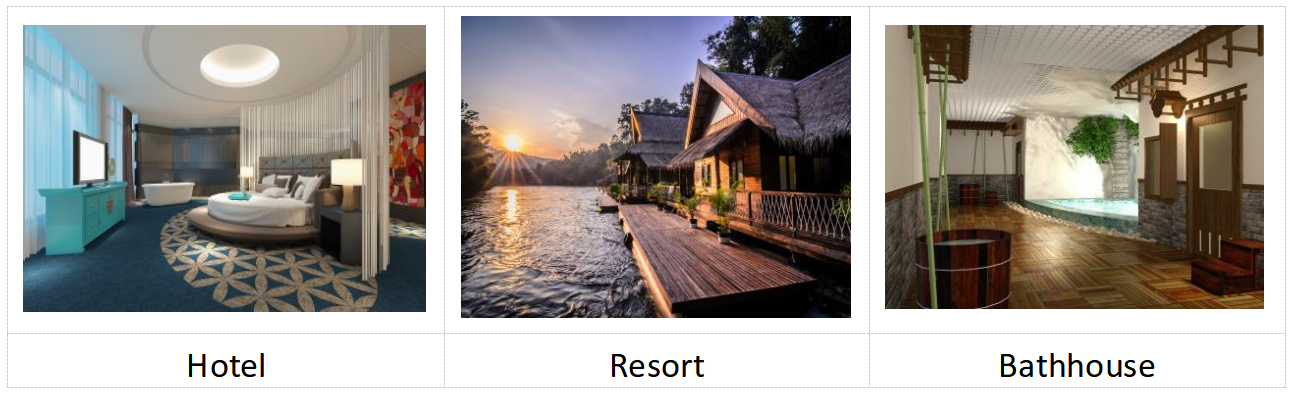
Hotels and resorts, as places that offer accommodation, leisure, business, and other services, have their guest experience and brand reputation directly influenced by the comfort of their environment. Central air conditioning systems are key infrastructure that supports this. Unlike industrial facilities that focus on processes, hotels and resorts need central AC systems designed with 'guest comfort at the core, scene adaptation as the basis, energy saving as support, and smart operation as a guarantee.' They must cater to the different needs of rooms, restaurants, banquet halls, pools, SPAs, and more, while balancing comfort with operating costs. Ultimately, the goal is to 'improve guest satisfaction, strengthen brand competitiveness, and reduce long-term operating costs.
Requirements
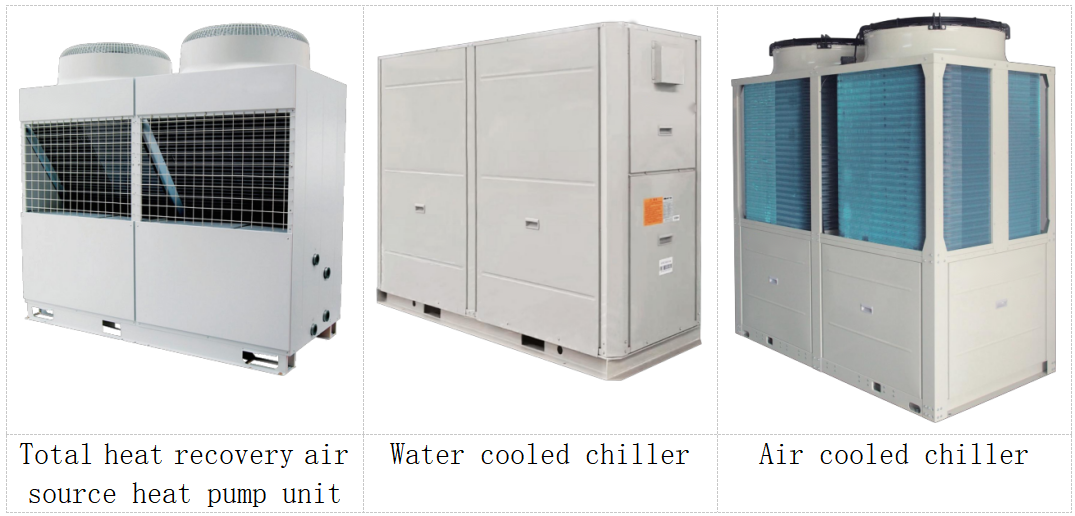
There are significant differences in the cost-effectiveness of different technical solutions. For example, screw chillers usually need a major overhaul of the screw compressor every 8 years, and a single overhaul costs about 12% of the equipment's original value, with an average annual maintenance cost of about 2.5% of the equipment investment. Air-cooled heat pump units benefit from intelligent microcomputer control systems, so their failure rates are low, and maintenance costs can be 20%–30% lower than water-cooled chillers, with an average annual maintenance cost of about 1.8% of the equipment investment. Multi-split VRV units have many connection points, posing a higher risk of refrigerant leaks and are more difficult to repair, so their annual maintenance costs are 15%–20% higher than heat pump units, about 2.2% of the equipment investment. These differences in maintenance costs need to be fully considered when choosing a technical solution.
MR Solution Description
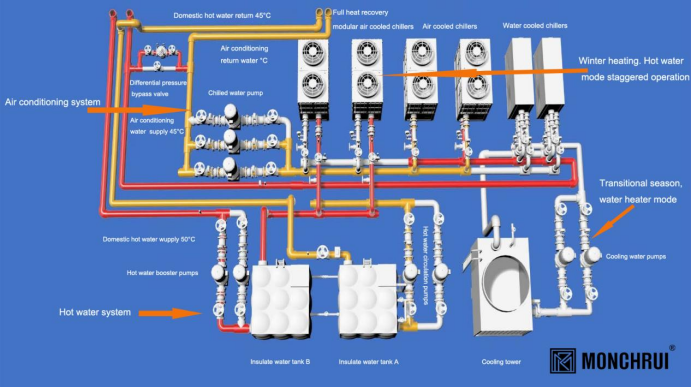
For hotels that need cooling, heating, and domestic hot water simultaneously, heat recovery air-cooled heat pump units are an ideal choice. These heat recovery units integrate multiple functions, using the condensation heat generated during cooling or the heat from heating operations to warm up domestic hot water, providing a steady supply of 55°C hot water. They improve overall energy efficiency by about 30% compared to traditional air conditioning solutions, effectively reduce energy consumption, and lower operating costs. The waste heat recovery efficiency can exceed 60%, further increasing comprehensive energy efficiency, and the investment payback period can be shortened to 3–5 years.
At the same time, if the project site has heat sources like lake water or groundwater, water source heat pump technology is another good option. The system uses water as the base heat source, converting the solar and geothermal energy in the water into efficient and environmentally friendly energy to provide HVAC effects for buildings. According to the principle of water source heat pumps, during summer, heat is transferred from the building to the water source to achieve cooling; in winter, energy is extracted from the relatively constant-temperature water source, and after heating it up, the energy is delivered to the building for heating. Currently, based on different types of water sources, water source heat pumps can be categorized into groundwater source, river and lake water source, seawater source, and wastewater source systems.
Used unit